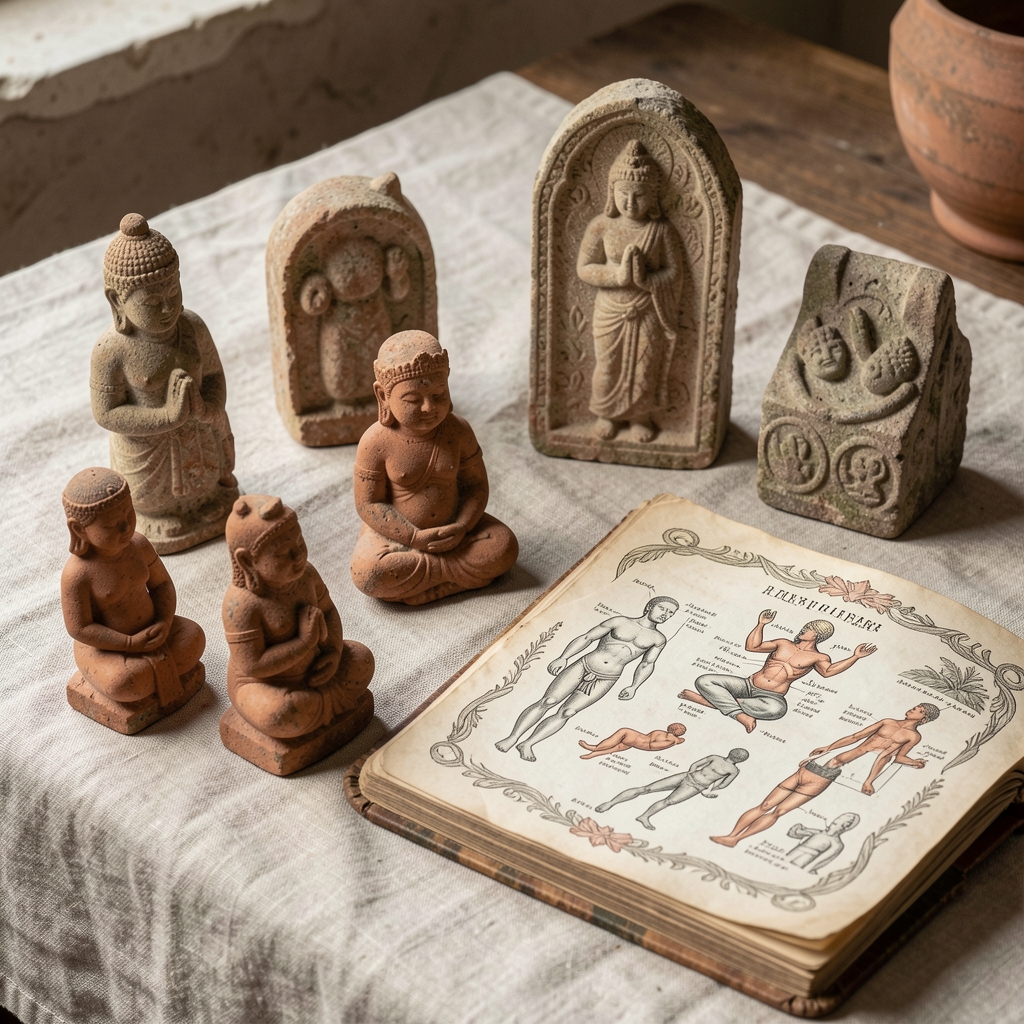
No civilisation has been indifferent to the question of how men maintain vigour, endurance, and a sense of physical capability across the years of active life. The answers have varied enormously — shaped by cosmology, by available knowledge, by social structures, and by the particular anxieties of each era. What remains constant is the attention itself.
Key Eras in the Understanding of Male Vitality
Classical Greece and the Humoral Tradition
Greek thinkers developed a framework centred on the balance of four humours — blood, phlegm, yellow bile, and black bile. A man's vigour was understood to reflect the proper equilibrium among these elements. Diet, physical exertion, sleep, and seasonal exposure all played roles in maintaining or disrupting this balance.
Chinese and Indian Traditions
Both Chinese and Ayurvedic frameworks developed rich, internally coherent systems for understanding male vitality. Chinese concepts of qi — the flow of life force through the body — and Ayurveda's three-dosha model each provided detailed accounts of how male vigour could be understood, assessed, and cultivated through lifestyle practices. These systems emphasised rhythmic living: seasonal adaptation, dietary modulation across the year, and the integration of rest and activity.
Monastic and Scholastic Perspectives
In the medieval European and Islamic scholarly traditions, the inherited frameworks of Greek medicine were systematically elaborated. Physicians and natural philosophers integrated the humoral model with religious and moral frameworks, producing accounts in which male vigour was bound up with spiritual discipline, dietary moderation, and a regulated daily order. The Regimen Sanitatis tradition — offering detailed prescriptions for seasonal eating, sleeping, exercise, and emotional management — was widely distributed and influential.
Industrial and Contemporary Frameworks
The industrial era brought new anxieties about male vigour, driven by the separation of physical labour from urban professional life and the emergence of new social expectations. Late nineteenth-century physical culture movements responded to these anxieties with systematic programmes of bodily training. The twentieth century saw the emergence of biomechanical and biochemical models, and eventually the complex, multifactorial frameworks of contemporary lifestyle science.
What Historical Perspectives Reveal
Looking across these traditions, several recurring themes emerge. First, the importance of regularity and moderation: most historical frameworks placed emphasis not on peak performance but on the maintenance of a sustainable, balanced daily rhythm. Second, the integration of body and environment: ancient systems rarely treated the body as an isolated system, but rather as responsive to climate, season, social life, and emotional state.
Third, the cultural specificity of definitions: what constituted male vigour in fifth-century Athens was not identical to its counterpart in Song Dynasty China, which differed again from Renaissance Florence. These definitions were always embedded in particular social structures, cosmological frameworks, and material conditions.
"Every era has its own map of the male body — and every map reflects the values and anxieties of the people who drew it."Prism Editorial
The Continuity of Lifestyle Emphasis
Despite the enormous diversity of frameworks across cultures and eras, one thread runs through nearly all of them: the understanding that day-to-day patterns of living — how men ate, moved, rested, and engaged with their environment — were central to the maintenance of vitality. The specific theories differed, but the fundamental intuition that wellbeing is built and sustained through accumulated daily practice remained remarkably consistent.
This historical continuity does not constitute proof of any particular modern claim, but it does suggest that the question of lifestyle and wellbeing is not a contemporary invention. It is a persistent human preoccupation, one that different epochs have answered in different ways, each leaving traces that continue to inform current understandings in more or less acknowledged ways.